Tuesday, April 27, 2010

Problems in Paradise.


For anyone living in France and relying on an income from the UK these have been hard times. Sterling has taken a real bashing over the past eighteen months and even though France has been relatively lucky in avoiding the worst effects of recession it has not been immune to inflation. Add these two facts together, and you have some pretty unhappy expats.

Judging by recent postings on expat forums it would seem that there is a steady stream of disillusioned Brits selling up and heading home. Every day, it seems there are small ads. offering left hand drive cars with low mileage, nearly-new white goods, and of course houses, some renovated, some in the process of.

There are as I see it three main reasons for abandoning the dream.
For the under-fifties who have relocated here and need to earn a living the sheer practicalities of the idea are a nightmare. One of the big dreams has been running a B&B (chambre d’hôte)or renovating tumble-down barns into gites, two enterprises that are reasonably easy to set up in Britain. Not so in France.

Many expats come with a trade - electricians, builders, and plumbers – again a pretty straight forward occupation to persue in the UK. But to start any sort of business in France is an obstacle course in which (especially if your French is a bit basic) the participants are blindfolded and handcuffed.

And it doesn’t matter how small your enterprise is going to be. I met a young couple last year who had jumped through every hoop the Chambre de Metiers could produce in an attempt to sell Asian food and spices on a few local markets. It was hardly on a global scale and after a few months of struggling they felt defeated and deflated. They were regretfully returning to the UK, but with the vow, like General Macarthur, to return, albeit when they were closer to retirement. The rules and regs. have been loosened a little in the last couple of years, with the creation of the Auto-entrepreneur scheme specifically for small, one- man businesses. But its still a little shop of horrors.Some returning expats can become a bit paranoid and actually believe that the French have it in for Brits wanting to earn a living in their country, but they forget that French entrepreneurs have to go through the same struggle.

The over-fifties may not have the this problem, as by and large they tend to be early-retired with a good pension pot, or investments, or older retirees with a state pension and perhaps a small private pension. But it’s this latter group that have been suffering from the strength of the euro, so this is one of the major reasons for returning to the UK.

Another common thread for the over-fifties is family ties, and in particular grandchildren.Even with technology such as Skype, and webcams, many retirees (I have to say it’s usually grandmas) genuinely miss seeing their grandchildren on a regular basis. Those cheap air-fares that convinced us that friends and relatives could pop over for long weekends don’t seem that cheap when you come to the ‘pay now’ bit the online booking form. How did a 99p one-way ticket suddenly turn into the £130 debited to your bank card for a return for two adults? With mortgages to pay, rising prices and limited holiday allowance, sons and daughters just can’t afford to hop over with the grandchildren more than once a year.

Well, you might say, what’s wrong with older grand-kids coming over for a few weeks in the summer holidays? Brilliant idea. The brutal truth is that the lovely old farmhouse you bought in the middle of no-where, which you fell in love with for its peace and tranquillity is ‘Boresville Central ’ for teenagers. Four weeks with Granny and Grandad down a country track miles away from the nearest town seems like a prison sentence.

So with regret many retirees put their idyllic hideaway on the market, and pack up their retirement dream along with their dogs, cats and memories and move back. Often they disguise their loneliness by convincing themselves that their grown up children need them for child care duties. This may seem a selfless act of parental loyalty, but I wonder how many sons and daughters may actually dread the idea of Mum and Dad moving back to a house down the road?

A harsh reality of life in rural France for many expats is loneliness. And that affects all ages. I met a charming girl a few weeks ago, who moved here about a year ago to live with her partner in the house he was renovating. The views from the garden were spectacular, a pretty little village was less than half a mile away – I would have died for the location- but they were selling the house, and everything in it, and moving back. Lack of a regular income was the main reason, but she seem to be quite relieved as she’d been so bored and lonely when her partner was out at work. He spoke good French - she didn’t - so she was completely isolated. There was no-one around that was vaguely her age even if she had been fluent in the language, and in rural areas friendships are hard to establish. In this France is no different to any British village, xenophobia flourishes in backwaters.

Sometimes we need a good listener, either to help solve a problem, or just to have a moan to, and being so many miles away from close family can turn minor niggle into a full blown crisis. Fortunately help is at hand. There’s an excellent English speaking organisation, run by volunteers who understand the problems of life in a different country and culture. It’s similar to the Samaritans in that there is a dedicated phone line with listeners on hand to do just that … listen. They are specially trained and entirely non-judgemental, so in fact for some it’s much better than talking a problem over with a friend. How many of our friends can really be relied upon not to criticise or offer well-meaning, but wrong advise?

Their website is www.soshelpline.org (there's a link in the right hand column of this blog) and the phones are manned from 3pm to 11pm. And if you’ve time on your hands you can volunteer to train as a listener. If you don’t feel you could do that, there’s lots of other ways to help – from distributing publicity, to organising a fund raising event like a book sale or a coffee morning.

Monday, April 19, 2010

Au Revoir Cup Cakes, Bonjour Macarons


Personally, I’ve never been a fan of cup cakes. I guess I’m too old.

In my day cupcakes were known as fairy cakes, the staple of childhood birthday parties (together with those disgusting rice krispie/chocolate things). My dear old Mum, she of the culinary disasters, never really got the hang of cake decorating, and anything involving icing was sure to end in tears. So my birthday offerings were neither tasty nor artistic. From memory, the cake bit was dry and the topping was a drizzle of icing with a scattering of hundreds and thousands which had been applied before the icing had started to set, so consequently the hundreds and thousands either dissolved into a lurid splodge of purple, yellow, pink and blue, or they slid gently off the top of the cake and collected in a pool around the rim of the paper case. Needless to say, there were always dozens of them left over at the end of the party, even though Mum had shovelled as many as decently possible into goodie bags for the departing guests. I guess most of them finished up in the dustbin or on the bird table. There were quite a lot of bird mortalities in our street just after my birthday.

The modern day ones, on which small fortunes have been made, are almost as bad. Mum’s lack of decoration was distinctly minimalist compared to these overblown works of confectionary. I regard any highly decorated cake with suspicion as they rarely live up to their promise, and those who were falling over themselves to be seen as cupcake connoisseurs are now admitting that most of them were dry and flavourless, and horror of horrors – laden with empty calories. If you’re going to be reckless with the calories at least get some satisfaction from it, I say. I’d opt for some Belgian chocolate, a slice of ‘Death by Chocolate’ cake, or a ‘proper’ dry martini (as made by a barman in Zaragossa in Northern Spain, but that’s another story)

Now it’s macarons that are the latest trendy confection. Not macaroons, they’re those big, flat almondy things which come with their own rice paper liner. Macarons are much more subtle.

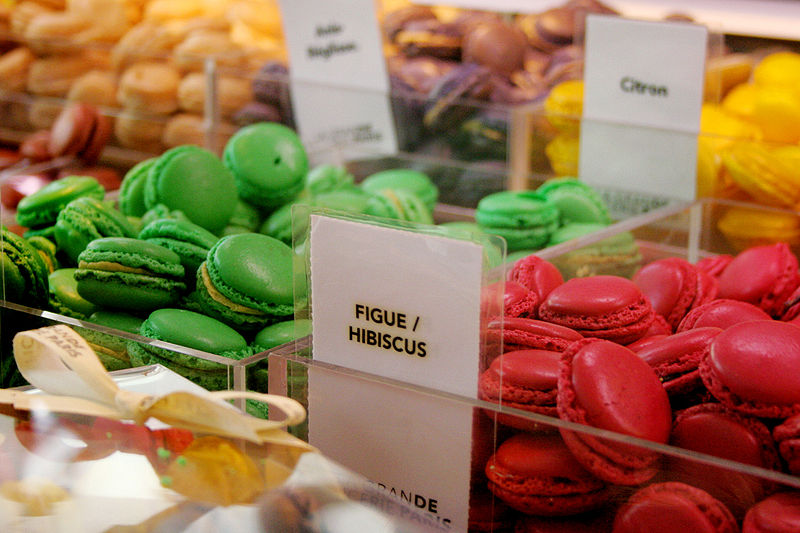
So if cupcakes are passé, here come the macarons, little jewel-like delights of pastel coloured meringue sandwiched together with a rich butter cream filling.

Macarons have been around for years in France, although the word is derived from the Italian word maccarone. It’s reputed that they were introduced to France by Catherine de Medici following her marriage to the French king, Henri II in 1553. Mind you, so much in France has been attributed to Catherine de Medici it’s probably yet another myth.

Unlike macaroons, the macaron is small, neat and incredibly difficult to make at home. The finished result must be uniform, as they are going to be sandwiched together, and have a smooth shallow-domed top ( no peaky bits) It all sounds too tricky, unless you’re really skilled in the art of meringue making.

The fillings are divine. Anything from the traditional chocolate, coffee and raspberry (appropriately coloured meringue to match he flavouring) to pistachio, chestnut, orange blossom, mango, bergamot – new flavours seem to be added every day.

If you’d like to know more, visit the website of one of the best macaron makers in France .. www.laduree.fr. They have shops in Paris and many other French cities, as well as Dublin and London (Harrods). The website should really come with a warning: ‘Macarons can become addictive’.

Thursday, March 18, 2010

Is It Really Here?


I think it’s safe to say that Spring might have arrived at last. Of course that could be a bit premature; the last time I thought that winter had finally pushed off was about a month ago, when the temperature rose, the sun shone and on a day out, we actually managed to eat our sandwiches in a picnic area without coats.

February is usually a great month for Spring-like weather in the Haute Garonne. We’re blessed with short winters which, even though they might be cold, are at least bearable. The knowledge that by the middle of February we could be sitting out in the sun gives us something to look forward too.

When I say ‘sitting in the sun’ I don’t mean I’m stretched out on a sun lounger in shorts and a strappy top ( a sight which should not be inflicted on those of a delicate disposition), it’s more like light sweater and jeans and sitting in a south-facing position.

This is what rattles me about those grumbling crumblies in the UK who have an annual chip at expat OAP’s who receive the government winter fuel allowance. For a start not every retiree gets it … it’s only paid if you were already getting it before you left the UK; everyone in receipt of a retirement pension has paid in to the system over a period of at least forty years so it’s not a charitable freebie, and lastly (and hilariously) there is a certain section of UK pensioners who actually think that south of Calais the temperature never drops below 20c. I heard an old girl on the Jeremy Kyle show rabitting on about this very subject when I was in the UK last year. Bless her heart, she actually seem to think that we were all spending the money on cheap booze and fags. I suspect she regarded anyone who left Britain to retire to pastures new as traitors and as such certainly didn’t deserve government hand-outs.

Well I can tell her that we had it cold enough to freeze the thingies off a brass monkey this year, and every winter it’s cold enough for a 15 tog duvet, so there! 150€ worth of wood keeps one room warm for about three months, providing we don’t light the fire until 6’clock in the evening and additional heating by way of radiators probably puts the electricity bill up by 75% on the summer quarters.

Not that I’m grumbling – the winters here are dry, crisp and bright even on the worst days. My recollections of East Anglian winters are dominated by memories of days that never seemed to get light. And an awful lot of mud. The roads around my village are nearly always clean, dry and mudless, but then this is cattle country, devoid of sugar beet lorries en route to the processing plant.

The garden has suddenly put a spurt on, as we knew it would once the temperatures rose, The daffodils were open enough to provide me with a Mother’s Day bouquet ( I live with a cheap skate who prefers to grow me flowers rather than buy them, but it’s the thought that counts). The crocus are always a hardy bunch, they keep coming through whatever the weather, as do the primulas which have self-sown themselves from the communal open ground at the rear of the garden. The trees have developed a delicate green haze and even our gorgeous Aubrac cows are looking happy. Yes, I’m going to stick my neck out and say “ Printemps est arrive. ”

Wednesday, February 17, 2010

Keeping Out the Cold


I really shouldn't have mentioned the fact that the snow had gone, because last week it came back again. Not in great amounts, but enough to make everything look pretty, and to send the temperatures plunging. I think this has to be the coldest winter we have experienced since we have been here; either that or it's just that I'm nine years older, so perhaps I'm feeling the cold more than I used to. I remember a few years ago some brainless Government minister suggested old people who were suffering in cold, badly heated, even more badly insulated houses, should wear a woolly hat indoors to prevent heat escaping from their heads. Well, what a brilliant idea - thousands of OAPs wearing bobble hats whilst watching 'Corrie' wrapped in a blanket ,sipping a Cup-a-Soup. Is there any wonder we escaped to France?

I do get a bit annoyed when I hear of attempts to stop ex-pats, living within the EU, receiving the British Winter Fuel Payments. There seems to be a general misconception, mostly amongst non- expat pensioners that those of us who have chosen to retire abroad are all basking in 365 days of warm sunshine, stretched out in January on the beach or the patio quaffing treble G& T's. Well, I've got news for them - nowhere in Europe has the sort of climate where you can do that, even Spain can get pretty nippy on a winter's night. And when the temperature sinks to - 12c as it does here, a G&T is the last thing you want. A cup of hot chocolate is much more attractive.

The French departments who have the Pyrénean chain as their backdrop are well versed in cold- prevention. They have plenty of warm, comfort food to off-set the effects of winter. Home- made soups are cheap, uncomplicated and nourishing, and unless we're out in the morning, and I haven't got any in the fridge from a previous lunch, we have some variety of soup every day.

In SW France, roughly within the Haute Pyrénees/ Aquitaine/Landes triangle the cold- buster is garbure, a cross between a soup and a stew - a 'stoup'as an old friend used to call it.


Garbure is such a highly regarded speciality that there are garbure festivals devoted to the dish. Argelés Gazost, near Lourdes, and Anglet, on the Atlantic coast between Biarritz and Bayonne, both have colourful festivals with traditional songs, dances and of course plates of garbure.


  • If you aren't within striking distance of either of these towns you can always make it yourself, and the good part about it is that it can be served as a lunch time soup or a main evening meal, with chunks of crusty bread. Garbure contains white beans, root vegetables, cabbage and a changing variety of meats. These can be pork, Bayonne ham, (or any jambon de campagne) confit of duck, or chicken thighs. Like all good soups it’s very much a case of throwing in whatever meat is available. Whatever is added to the basic recipe, it must be thick enough to stand a spoon up in.

    I’m going to give you the Sunday-Best, High-Days-and-Holidays recipe so you can omit some of the meat if you wish, but keep a bacon flavour by still using some pieces of jambon de campagne or a ham bone. If all else fails, some bacon lardons will do …at a push!

    For a traditional Garbure to serve 6 you will need:

    1 large onion

    4 celery stalks

    1 large leek

    4 medium potatoes, peeled

    1 medium turnip or 2 good sized carrots, peeled

    4 or 5 cloves of garlic, crushed

    250 g white haricot beans (soaked overnight)

    150 g jambon de campagne (or the bone if you can scrounge one from your friendly neighbourhood deli)

    200 g salt pork belly

    2 confit de cuisses de canard (confit of duck legs)

    2 litres water

    bouquet garni and salt and pepper.

    Half a savoy type cabbage, finely shredded.

    A large saucepan with a lid

    Scrape some of the fat from the confit de canard ( if using) into the saucepan. Otherwise cover the bottom of the pan with a light vegetable oil. Heat gently.

    Roughly chop the first 5 ingredients and add to the saucepan. Sauté lightly adding the crushed garlic after a few moments. Then add the pork and ham (or the lardons) cut into smallish cubes. Don’t brown the vegetables off too much, they just want to soften and absorb the duck fat or oil. Add the drained and rinsed haricots, the water, bouquet garni and seasoning (go easy on the salt until the final tasting). Bring to the boil, then cover and simmer for a couple of hours

    Test the beans are soft, then add the shredded cabbage and the duck legs, with most (but not all) of the fat removed. A little fat will improve the flavour and texture of the soup. Do not throw the rest of the duck fat away on pain of death! Scrape it into a bowl, and use for roast potatoes later. It makes ‘roasties’ to die for! It will keep in the fridge for several weeks

    Cook the soup for a further half hour.


    The traditional way of serving is to pour portions into a soup bowl lined with slices of day-old rustic bread, but this is not obligatory and can be messy! In more impoverished times the meat would have been removed and kept warm to be served as the main course with salad. Today the whole dish, which should by now be really rib-sticking, is usually eaten as a lunchtime treat on a chilly day with lots of freshly baked ‘pain de campagne.’ Another tradition was to pour half a glass of red wine into the last few spoonfuls of soup to ‘aid the digestion.Chacun à son goût! It's certainly á mon goût.

Sunday, January 24, 2010

What's in a name ?

<
<


In case anyone should think I am permanently attached to a laptop (heaven forbid) my other overriding interest is food – in particular, the sourcing, preparation and consuming of it.

In the winter I dream of warming soups and stews; in the summer I plan meals grilled over a barbecue and served with adventurous salads. By adventurous salads, I mean something more than lettuce, tomato and cucumber, with side orders of radish and spring onions - my mother’s standard summer fare. My mum’s enterprising attempts at livening up the tea time salad might occasionally involve grating a carrot, or reincarnating the lunch time left over potatoes by covering them in a dollop of salad cream (mayonnaise was virtually unheard of). This was as adventurous as it got.

If she could see the wild assortment of ingredients that are melanged into a salad now, she would declare that “folk are better fed than taught”. It was an expression she used liberally, and to this day I can’t work out the literal sense of it, except I think she would have applied the same comment to the avid consumerism that we see in the 21st century. She would have been very contemptuous of such culinary novelties as bean and pea sprouts (Brussels were the only sort she knew, and you didn’t serve them raw, they needed boiling for at least ¾ of an hour)) awabi radish (what was the matter with French Breakfast?) and olive oil ( well that came from Boots in a small bottle and you warmed it up and dripped it into your ears to soften the wax). Our French doctor nearly fell off his chair when I told him that one.

We Brits were quite accustomed to being the butt of our continental neighbours' jokes when it came to food, and I think it gave us an unwarranted sense of inferiority. We can cook just as well as the French, and our classic regional recipes are equally as good as theirs, in fact sometimes they can be better. Where we go wrong is in the name. We are just not inventive enough.

Take the potato. Being half Irish, I adore potatoes. Were the human race to be left with nothing else but potatoes to eat, it wouldn’t bother me a bit. That’s one reason I can’t be doing with low carb weight loss plans like the Hay Diet. I’m sure it’s great, and I know people who swear by it, but I can’t face eating protein without some form of carbohydrate; I love pasta, I like rice, but I worship at the altar of the humble spud. I have yet to find a French potato that comes anywhere near a British one for texture and flavour, but we’ll skate over that.

A natural companion to potato is cheese. Both the British and the French have cottoned on to this , so we both have perfected comforting, warming dishes using these two basic ingredients.

What do we call ours? Interestingly, cheese and potato pie. And the French version? Tartiflette.

The former is mashed potato and grated cheese, beaten together with butter and milk, spread in a pie dish, topped with more grated cheese and browned in the oven. The French variant uses sliced potato, a slug of white wine (comme d’habitude)and a topping of reblochon cheese. But it isn’t common old cheese and potato pie, it’s tartiflette.

It’s a name to conjure with. It elevates cheese and potato to realms far above their station. It’s a cheeky, pert little word …. it deserves to be up in lights - Mimi Tartiflette the Parisian burlesque dancer. Or in the pages of a crime novel – Alfonse Tartiflette, the unorthodox detective from the Quai D’Orsay.

You never see ‘Cheese and Potato Pie’ on a restaurant menu in the UK and yet ‘Tartiflette’ is all over the place in France. You can even buy it in tins, or frozen, in 4- portion bags, if it’s too much effort to peel all those potatoes.

Here in Southwest France we have another cheese and potato speciality that is almost sacramental. It has to be made with a certain type of cheese – laguiole -which is produced in the Aubrac region of the Midi Pyrenees.It involves creaming mashed potato and garlic over a low heat and beating the laguiole cheese into it. This cheese and potato puree has almost mystical qualities and is known as aligot (pronounced al-ee- go) It’s also ridiculously expensive to make because of the cheese that must (on pain of death) be used … emmenthal or simlar melting cheese is a complete anathema to purists - a cantal of a certain age may be acceptable in some regions, but the whole thing is fraught with argument, as is so much in France. Like tartiflette this traditional recipe has been brought into the supermarkets in easy- cook packets; ready to warm up in plastic sachets, or dehydrated (just add warm milk) Surely that’s cheesey Smash? No, it’s aligot.

I have a theory that if we renamed our simple dishes, gave them pretty, or exotic names instead of boring titles like fish pie, or bizarre names like toad in the hole, we might get a bit more international recognition.


Tartiflette is a great lunchtime dish on a chilly day, so here’s the recipe:

I should really say ‘Here is one of many recipes for tartiflette.

For six to eight people you will need:

About 750 gs of potatoes (peeled)
A large onion (chopped)
A 250 pkt lardoons
A glass of dry white wine
A round of reblochon cheese
Salt and pepper to taste

The ingredients are universally accepted as being correct. The method differs from cook to cook, so here’s how I do it.

Cook the potatoes whole, in lightly salted water, for about ten minutes. They should still be quite firm as they are going to be cooked again. Drain and when they are cool enough to handle, slice into not-too- thin slices.


Melt some butter into a frying pan, and fry the onion and potatoes together until lightly browned, add the lardons and enough wine to simmer the potatoes for a few minutes without boiling dry. Drink the rest of the wine… ...no point in trying to put it back into the bottle. That's one of my rules of life.

Gently spoon the onion- potato- lardon- mixture into a large gratin dish. Cut the reblochon in half through the middle, and (this is where there is some dispute) either place the two halves of cheese rind side up or down on top of the potatoes.

Cover with some baking foil and cook in a hot oven (200c) for half an hour or so. It’s an easy-going dish, so timing isn’t crucial.


Next blog ..... France's deep and lasting relationship with cheese and potatoes.

Monday, January 18, 2010

Procrastination is the Thief of Time


Well the snow has gone, from the towns and villages at least, although there is still enough on the mountains to keep the skiers happy.

I’ve a touch of the January- post- Christmas blues. January has to be the worst month of the year, although when the sun does put in an appearance it’s got quite a lot of power in it. Unfortunately when you live in an old house, the walls are thick, which is fine for keeping the worst of the cold out, but it also means that sometimes it’s warmer in the garden than in the kitchen.

The kitchen is my writing/cooking/web-surfing sanctuary, consequently I spend many daylight hours wandering from computer to cooker, to coffee pot, but last week it was so cold in there (despite the radiator devouring electricity units at an alarming rate) that writing became a real chore. Cold rooms and writing seem to go together; the most successful writers have all shivered in bed sits, writing in a top coat and mittens. JK Rowling apparently wrote a lot of the first Harry Potter book sitting in a coffee shop because it saved on the fuel bills… she must have made a cup of coffee last an awfully long time. The delightful Marion Keynes writes on her laptop, snuggled up under the duvet. I’ve tried that and it’s almost impossible - the laptop keeps sliding all over the bed.

Not only do my fingers freeze up, so does my brain. I can’t concentrate on serious writing. In an effort to make it look as if I was actually working last week, I decided to spend the time by doing some earnest Googling in the name of research. I’d got several writing requests sitting in my inbox which were going to require some dedicated exploration, and web page clicking wasn’t going to be as bone -chilling as having to relentlessly type on a cold keyboard.

As those of you who try to earn a crust by writing will know, anything that distracts us from actually having to sit down and face a blank Word document is a gift from God. Search engines are both a blessing and a curse, and I really ought to have a parental block installed on my laptop to prevent me accessing internet auction sites, and other people’s blogs.

I decided to have a browse around the camera category of Ebay. I have talked myself into the notion that I really need a camera of my very own, rather than having to struggle with the all- singing- all dancing one belonging to Captain Sensible. There are times when even he can’t make it behave, so what chance have I got?

Anyway I had a lovely afternoon surfing comparison sites, reading camera reviews, most of which went right over my head, and the next afternoon deciding which one I was going to bid on, and the next afternoon clicking back and forth to the Ebay site, to make sure I hadn’t been outbid.

So I actually wasted three afternoons, bought myself a camera, and discovered nothing about black truffles which had been the point of all that Googling.

I’m going to google ‘Perigord Truffles’ when I finish this blog. That will be a disaster, because the devilish Google will lead me off down the path of foodie sites, French truffle producers sites, and any blogs that happen to have the words Perigord truffles buried in their pages.

I’m putting some of Captain S’s photos on this page, just to cheer everyone up and prove that his bells- and-whistles camera can be persuaded to take good pictures when it’s in the mood. We had an autumn break in Pau last year. Pau is a lovely city right on the edge of the Pyrenees. It’s only 50 miles from us- we get less adventurous as we get older! Lots of people only know Pau as a destination on the Ryanair website, which is a shame as it’s well worth a visit, with great views, an elegant castle and some smart shops.


Sunday, January 10, 2010

Snowed In


Well, at last we have snow. You have no idea the guilt that is experienced down here when we see weather forecasts and news reports from the UK showing snowdrifts and chaos.

Ours arrived on Thursday, we were expecting family but we got snow instead. Gatwick wasn't going anywhere so all the food I had in the fridge is either in the freezer or us.

The village has been a fairy-tale for three days, but somehow snow is wasted on the over- thirties. It looks lovely (from the window), especially this afternoon as the sun is shining and the sky is blue, but I'm so pleased the road is thawing, and the pavements almost clear. The up-side is that all the runs on the ski stations must be open by now, and that's got to be good for the tourist trade.


The forecast is for warmer weather on the way, so I guess by next weekend our snow will be nothing more than a memory and some photos. Which is fine by me. It's not an age thing - I was a complete wimp when I was kid. I hated going to school in the snow. The boys would have always made the most deadly slide in the playground (rivalling the Cresta Run)and it always seemed to be across the school entrance, so impossible to avoid; I hated being hit by snowballs and I hated wet gloves so much I never made any ammunition to fire back. I was terrified of slipping over on the ice on the way home in case someone saw me and laughed ... all in all I was a proper party pooper in the snow.

The saving grace was frozen milk. Free school milk (pre Thatcher) was delivered in crates containing glass bottles of,I guess, a quarter of a pint, with a cardboard top which you normally pierced with your thumb to enable you to stick a straw into the bottle. In a hard winter the cream which rose to the top conveniently froze and often half-pushed the top off ...dead hygienic! To us simple, post-war kids it was just like ice cream(Mr Whippy had yet to arrive). Of course, conversely the milk in summer was either warm, or in a very hot summer,going off. There is an upside and a downside to everything in life.

Strangely I don't ever recall the school closing during a particularly hard spell. I'm sure if it had I would have remembered it. It would have been the answer to a prayer for a snowaphobic like me.