Saturday, July 17, 2010

Racing Bikes and Fireworks


July and August are the months when it all kicks off here. Well, ‘here’ is no different to the rest of the country. For 10 months of the year the Haute Garonne jogs along at a fairly even pace – a ‘vide grenier’ every other Sunday somewhere, a ‘fete locale’ a repas de chasseurs, a Feu de St Jean (which is a good excuse for a meal and a bonfire) – nothing exceptional. But in the next eight weeks the department will go stark raving mad.

The celebrations commence with the commemoration of the Revolution. July 14th used to be known as Bastille Day, but now it seems to be known by the more PC title of the Fête Nationale. All the blood letting which followed the storming of the Bastille has been diplomatically shelved in favour of a public holiday culminating in firework displays. Nowhere in France can compete with the Paris display – well the Eiffel Tower and the Champs de Mar are pretty impressive in daylight, but at night, with the sky exploding in a thousand stars, the city becomes magical.

The second best display must be the Feu d’Artifice mounted on the walls of La Cité in Carcassonne There the surrounding vineyards are illuminated by a cavalcade of fireworks which soar up from the city ramparts and roll down the rows of vines in an ever-expanding explosion of colour. The event draws in thousands who park up anywhere they can, unpack a picnic and sit it out till the night sky darkens and a lone rocket signals the start of the spectacle. The tourists prefer to cram into the old city to soak up the atmosphere, all they actually do is pay over the odds for a drink, and miss the best of the display because they can’t actually see it. But they’ll get plenty of ‘atmosphere’ – the smell of burgers and chips, pizzas and several thousand sweaty bodies struggling to navigate the crowded cobbled alleyways. Not to mention a crick in the neck, and temporary deafness when the fireworks go off from the city walls.
">


Old hands find a grassy knoll outside the city and bring their own food and wine. A few years ago the police had to close the Toulouse/Narbonne motorway due to the huge number of cars which had stopped on the hard shoulder to watch. Now it’s slightly more controlled, well, as far as the French ‘en fête’ can be controlled.

In the face of that sort of competition our nearest town had its firework celebrations the night before. On a suitably balmy evening after a very hot day, we joined friends at the lakeside restaurant, along with half the town, and several million flying things (ants, small flies? ) and watched the municipal fireworks, which like the Carcassonne ones are entirely free. The French government may have warned the nation that we must tighten our belts and not spend public money, but what the hell…. let’s all fiddle while Rome burns, except, being in France, we’ll replace the violin with fireworks.


In the week following the Fête Nationale the Tour de France descends on us for the Pyrenean stage of the endurance race. It usually passes within 10 miles of our village, and depending on the weather (it’s usually unbearably hot), how early they close the roads and if we have a ‘window’ in our non- existent social diary (life is one long party for retirees in rural France!) we sometimes endure a couple of hot sticky hours waiting for the pelaton to whiz past.

What am I complaining about? I’m not clad in sweaty lycra, bent over the handlebars of an instrument of torture otherwise known as a racing bike. I’ve yet to understand why they choose the hottest month of the year to stage the thing. I’m obviously missing the point, as I usually do where physical activity is concerned.

Now I have a small grandson I probably should be out there with all the other grannies and granddads scooping up the rubbishy freebies that the ‘caravan’ throws out to the eager masses. I sometimes wonder if the crowds are there to watch the race, or collect free samples of coffee, coloured pencils, packs of kids card games and cheap hats that rain down from the vans, cars and lorries. The riders speed by in a matter of seconds so I guess the freebies are the major draw.

The last time I watched Le Tour one of the riders lost a water bottle and two blokes nearly fell into the Garonne to get it. It was probably for sale on Ebay by six o’clock that night…. ‘as used by Lance Armstrong’.

As well as the major events we’ve the usual crop of August music festivals, everything from organ recitals, to hot jazz. And in case thoughts are turning to Christmas, there’s the annual exhibition and sale of Provencal santons in Saint Bertrand de Comminges. What better time to choose your Christmas crib than August?

Tuesday, June 22, 2010

Look Out Carla's About!


Last Friday saw the 70th anniversary of General de Gaulle’s first speech via the BBC to the newly occupied French people urging Frenchmen to join him in resistance to Hitler and the Vichy government. It is quite ironic that very few French people actually heard the broadcast, and those that did, hadn’t a clue who he was. Indeed some cynics thought, with a name like de Gaulle, he was a pseudo Frenchman invented by the British government in an attempt to stir up French national fervour. As if we would! Well, not for nothing did the French refer to us as ‘perfidious Albion’.

Strangely, for no-one having heard him, and the BBC not having thought it important enough to save the original broadcast, every word of it can be recalled. So much so, the opening paragraph is engraved on the war memorial of our nearest market town. Oh well, it’s always said a prophet is never recognized in his own country!

Anyway the old boy got plenty of mileage last week. Nicolas arrived in London with medals to award to veterans now in their nineties (better late than never one might say) plenty of kepi-wearing military attachés, and of course Carla.

Oh dear, Mlle. Bruni should really come with a health warning – to other leader’s wives. They should be briefed on the multitude of tricks the French First Lady has up her model’s sleeve, and make sure they never stand next to her for a photo shoot.

Pity poor old Samantha Cameron. Being five months pregnant is tricky. The bump is too big not to be noticed and too small to be in the beautiful full bloom of late pregnancy. She’s sort of at that lumpy stage, and she hasn’t a clue what to do with her hands. There’s not enough there to rest her arms on top of the bump, so she clasps them underneath it, like she’s afraid it’s going to fall off. Someone give her a handbag, for heavens sake. But you have to have some sympathy for her Anyone who’s five months pregnant, and new to the job of consort to the Prime Minister, would rather die than be photographed beside someone as media-savvy as Carla Bruni.

World leader’s spouses must dread the words ‘The French President is making an official visit and he’s bringing his wife with him.’ Except Michelle Obama. As she’s about 8 feet tall, and built like an Olympic sprinter, she can well hold her own with Carla, as is proved in the photo taken on a visit to the White House; in fact Mrs. Obama makes Carla look quite washed out. Anyone but the American First Lady might as well abandon all hope of looking chic

I’ve noticed Carla is nowhere to be seen when hubby is meeting Angela Merkel …. is this a coincidence, or some smart maneuvering on the part of the German Chancellor? Maybe she arranges for her to be accidentally locked in the loo when the official photographer arrives. She’s no fool, is Angela. She’s also, bless her, incredibly dumpy so she knows the score.

Mrs. S was up to all her old tricks in London. She, like the late Princess of Wales, can hear the click of a camera shutter at 300 yards and that’s when ‘model’ mode kicks in, well old habits die hard. So there she was, tossing her mane and skittering about like the winner of the 2.30 at Epsom. The pout, the flick of the hair, the flutter of the eyelashes, I’d have loved to have seen her and Lady Diana sharing the same platform. Wonder who would have won? I think my money might have been on Lady Di. Prince Charles, minus Camilla (had she been forewarned?) seemed to be reduced to a pink-flushed jelly when faced with Carla’s performance, but the Boy David, to his credit, ignored La Bruni’s shenanigans, preferring to put an protective arm round Samantha, who looked as if she would rather have been having an enema in the delivery room than posing in the doorway of number 10.

What Madame de Gaulle would have made of it all I’ve no idea, but I’ll bet it had the old general spinning in his grave.

Monday, May 24, 2010

A Lively, Lovely Weekend


Well it would seem we have survived yet another Pentecostal ‘Féte Locale’. Fortunately it only happens once a year, because it can amount to a good deal of sleep deprivation … if you happen to live in the centre of the village, as we do.

The féte, as in most French villages lasts over the weekend, and usually kicks off on Friday evening. For the past week lorries and big caravans have arrived, parked up on the salle de féte car park, and pitched camp. Like Boer ‘vortrekkers’ the caravans corral the dodgems, the floating ducks, the tombola, and the candy floss stall into a cosy circle. At the far end is the stage, from whence all the noise comes, with lights and amplifiers brooding silently over the fairground until the hour comes for it to spring into life. Round about 10.30 a deep, but persistent beat will erupt and it will continue until dawn breaks. We‘ve got used to it now, and thankfully, due to our thick walls and heavy shutters, when we go to bed we seem to be able to shut it out and get a reasonably good night’s sleep.

Friday and Saturday are given over to ‘les jeunes’. The proceedings kick off with a village ‘repas’ on Friday evening arranged by the salle de féte committee. The committee are all young people, which is in direct contrast to village committees in the UK, where the average age is about seventy. The food isn’t exactly ‘gourmet’ but the wine and digestifs flow, a good crowd turns up and before long someone will murder ‘La vie en Rose’, or ‘Mon Legionnaire’, before the oldies stagger home and les jeunes arrive for some unadulterated house music … or is it garage? Whatever it is it sure ain’t Piaf.

This year Saturday night was somewhat ‘livelier’ than normal. Around four in the morning some over-excited revellers decided to let off a barrage of thunder flashes. Not the great big ‘simulated- battleground- trainee- squaddies- for the use-of’ sort of thunder flashes, these were the domestic variety, but in the confined area of a narrow main street and village square they might just as well have . World War 3 (according to Steven Speilburg) was in imminent danger of breaking out, and even when the ammunition was exhausted the troops still had plenty of energy to return to the music, which after a brief breather, resumed with gusto.

Sunday was altogether quieter, with families pouring in from the surrounding villages around mid afternoon to sample the delights of the dodgems and the ‘barbe á pappa ‘ or granddad’s beard .. known to the rest of us as candy floss. Later in the afternoon the artillery arrived again and resumed their bombardment. Fortunately the bangs didn’t resonate quite as loudly in daylight. The music resumed but it ended earlier, about 2 am, perhaps the late night on the Saturday was catching up with them.

Today was essentially for the village. As is the custom with French fétes the celebrations start with a short service at the war memorial to honour the dead from the two World Wars. Shortly before 11 twenty or thirty villagers assemble at the church and walk the few metres to the memorial, lead by a side drummer and a bugler. The drummer adopts a funereal tone, reminiscent of the Revolution. I half expect to see a tumbrel, packed with condemned aristos, rumbling across the bridge en route to the guillotine. I think I’ve watched ‘A Tale of Two Cities’ too often, due to a schoolgirl crush on Dirk Bogarde, now totally demolished by reading John Coldstream’s 2004 biography on my teenage heartthrob.

The service is short; a bouquet is placed at the foot of the monument and the bugler launches into the ‘Marseillaise’. After this everyone retires to the bar for free drinks. An accordionist appears, the side drummer (suitably refreshed) shows off his supreme ability to perform single paradiddles and embarks on a musical duel with the accordionist. The battle seems to end in a draw.

Some considerable time later the bugler and the side drummer depart in their car. I wonder if they advertise themselves in the local free newspaper … ‘ Side drummer and bugler available for fétes locale, Bastille Day celebrations, VE day anniversaries and bah mitzvahs. Competitive rates’.

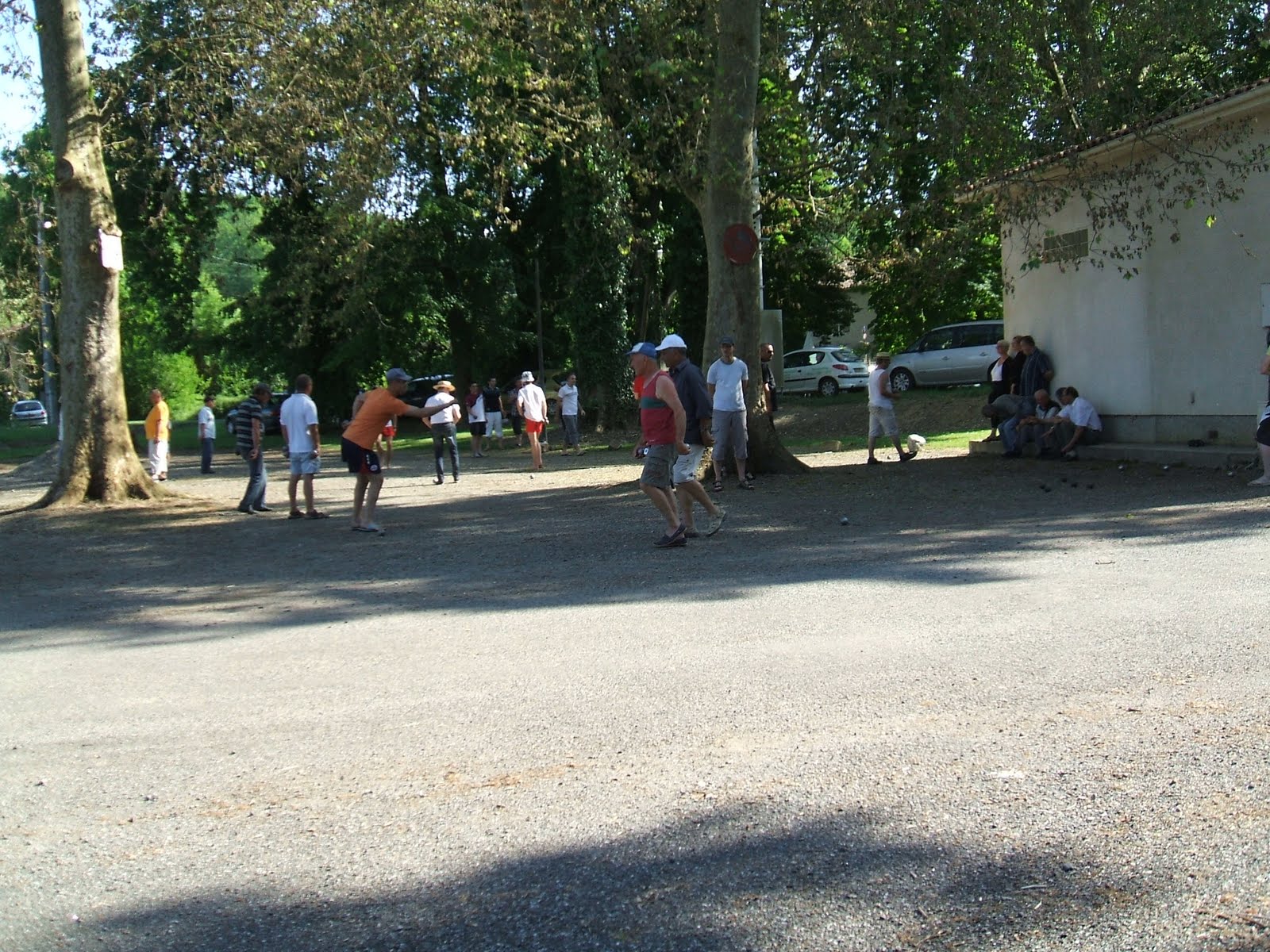
After this, the afternoon has been remarkably quiet. The boules tournament was well supported by players (all male) and spectators, and played under the shade of the trees, strangely boule is not a sport that’s played at any other time in the village; I think it needs a drowsy, hot afternoon and a plane tree-lined square, the sort you find in the south. It seems to go perfectly with pernod and water, and black olives.

We have had a perfect weekend, with the garden thermometer hitting the high 30’s, but it doesn’t always work out like that. The weather here can sometimes be as capricious as Britain just when you really want it to be nice. The week’s forecast looks gloomy, with rain and falling temperatures, but at least no-one rained on our féte.

There have been half-hearted attempts by the French government to abolish Whit Monday as a public holiday, due to the fact that some years (this one for example) the month of May sees 4 separate public holidays. Up to now it’s been blithely ignored, and judging by the fun everyone has had today, I can see little Sarky and his government in that tumbrel if they persist in enforcing it.

Tuesday, April 27, 2010

Problems in Paradise.


For anyone living in France and relying on an income from the UK these have been hard times. Sterling has taken a real bashing over the past eighteen months and even though France has been relatively lucky in avoiding the worst effects of recession it has not been immune to inflation. Add these two facts together, and you have some pretty unhappy expats.

Judging by recent postings on expat forums it would seem that there is a steady stream of disillusioned Brits selling up and heading home. Every day, it seems there are small ads. offering left hand drive cars with low mileage, nearly-new white goods, and of course houses, some renovated, some in the process of.

There are as I see it three main reasons for abandoning the dream.
For the under-fifties who have relocated here and need to earn a living the sheer practicalities of the idea are a nightmare. One of the big dreams has been running a B&B (chambre d’hôte)or renovating tumble-down barns into gites, two enterprises that are reasonably easy to set up in Britain. Not so in France.

Many expats come with a trade - electricians, builders, and plumbers – again a pretty straight forward occupation to persue in the UK. But to start any sort of business in France is an obstacle course in which (especially if your French is a bit basic) the participants are blindfolded and handcuffed.

And it doesn’t matter how small your enterprise is going to be. I met a young couple last year who had jumped through every hoop the Chambre de Metiers could produce in an attempt to sell Asian food and spices on a few local markets. It was hardly on a global scale and after a few months of struggling they felt defeated and deflated. They were regretfully returning to the UK, but with the vow, like General Macarthur, to return, albeit when they were closer to retirement. The rules and regs. have been loosened a little in the last couple of years, with the creation of the Auto-entrepreneur scheme specifically for small, one- man businesses. But its still a little shop of horrors.Some returning expats can become a bit paranoid and actually believe that the French have it in for Brits wanting to earn a living in their country, but they forget that French entrepreneurs have to go through the same struggle.

The over-fifties may not have the this problem, as by and large they tend to be early-retired with a good pension pot, or investments, or older retirees with a state pension and perhaps a small private pension. But it’s this latter group that have been suffering from the strength of the euro, so this is one of the major reasons for returning to the UK.

Another common thread for the over-fifties is family ties, and in particular grandchildren.Even with technology such as Skype, and webcams, many retirees (I have to say it’s usually grandmas) genuinely miss seeing their grandchildren on a regular basis. Those cheap air-fares that convinced us that friends and relatives could pop over for long weekends don’t seem that cheap when you come to the ‘pay now’ bit the online booking form. How did a 99p one-way ticket suddenly turn into the £130 debited to your bank card for a return for two adults? With mortgages to pay, rising prices and limited holiday allowance, sons and daughters just can’t afford to hop over with the grandchildren more than once a year.

Well, you might say, what’s wrong with older grand-kids coming over for a few weeks in the summer holidays? Brilliant idea. The brutal truth is that the lovely old farmhouse you bought in the middle of no-where, which you fell in love with for its peace and tranquillity is ‘Boresville Central ’ for teenagers. Four weeks with Granny and Grandad down a country track miles away from the nearest town seems like a prison sentence.

So with regret many retirees put their idyllic hideaway on the market, and pack up their retirement dream along with their dogs, cats and memories and move back. Often they disguise their loneliness by convincing themselves that their grown up children need them for child care duties. This may seem a selfless act of parental loyalty, but I wonder how many sons and daughters may actually dread the idea of Mum and Dad moving back to a house down the road?

A harsh reality of life in rural France for many expats is loneliness. And that affects all ages. I met a charming girl a few weeks ago, who moved here about a year ago to live with her partner in the house he was renovating. The views from the garden were spectacular, a pretty little village was less than half a mile away – I would have died for the location- but they were selling the house, and everything in it, and moving back. Lack of a regular income was the main reason, but she seem to be quite relieved as she’d been so bored and lonely when her partner was out at work. He spoke good French - she didn’t - so she was completely isolated. There was no-one around that was vaguely her age even if she had been fluent in the language, and in rural areas friendships are hard to establish. In this France is no different to any British village, xenophobia flourishes in backwaters.

Sometimes we need a good listener, either to help solve a problem, or just to have a moan to, and being so many miles away from close family can turn minor niggle into a full blown crisis. Fortunately help is at hand. There’s an excellent English speaking organisation, run by volunteers who understand the problems of life in a different country and culture. It’s similar to the Samaritans in that there is a dedicated phone line with listeners on hand to do just that … listen. They are specially trained and entirely non-judgemental, so in fact for some it’s much better than talking a problem over with a friend. How many of our friends can really be relied upon not to criticise or offer well-meaning, but wrong advise?

Their website is www.soshelpline.org (there's a link in the right hand column of this blog) and the phones are manned from 3pm to 11pm. And if you’ve time on your hands you can volunteer to train as a listener. If you don’t feel you could do that, there’s lots of other ways to help – from distributing publicity, to organising a fund raising event like a book sale or a coffee morning.

Monday, April 19, 2010

Au Revoir Cup Cakes, Bonjour Macarons


Personally, I’ve never been a fan of cup cakes. I guess I’m too old.

In my day cupcakes were known as fairy cakes, the staple of childhood birthday parties (together with those disgusting rice krispie/chocolate things). My dear old Mum, she of the culinary disasters, never really got the hang of cake decorating, and anything involving icing was sure to end in tears. So my birthday offerings were neither tasty nor artistic. From memory, the cake bit was dry and the topping was a drizzle of icing with a scattering of hundreds and thousands which had been applied before the icing had started to set, so consequently the hundreds and thousands either dissolved into a lurid splodge of purple, yellow, pink and blue, or they slid gently off the top of the cake and collected in a pool around the rim of the paper case. Needless to say, there were always dozens of them left over at the end of the party, even though Mum had shovelled as many as decently possible into goodie bags for the departing guests. I guess most of them finished up in the dustbin or on the bird table. There were quite a lot of bird mortalities in our street just after my birthday.

The modern day ones, on which small fortunes have been made, are almost as bad. Mum’s lack of decoration was distinctly minimalist compared to these overblown works of confectionary. I regard any highly decorated cake with suspicion as they rarely live up to their promise, and those who were falling over themselves to be seen as cupcake connoisseurs are now admitting that most of them were dry and flavourless, and horror of horrors – laden with empty calories. If you’re going to be reckless with the calories at least get some satisfaction from it, I say. I’d opt for some Belgian chocolate, a slice of ‘Death by Chocolate’ cake, or a ‘proper’ dry martini (as made by a barman in Zaragossa in Northern Spain, but that’s another story)

Now it’s macarons that are the latest trendy confection. Not macaroons, they’re those big, flat almondy things which come with their own rice paper liner. Macarons are much more subtle.

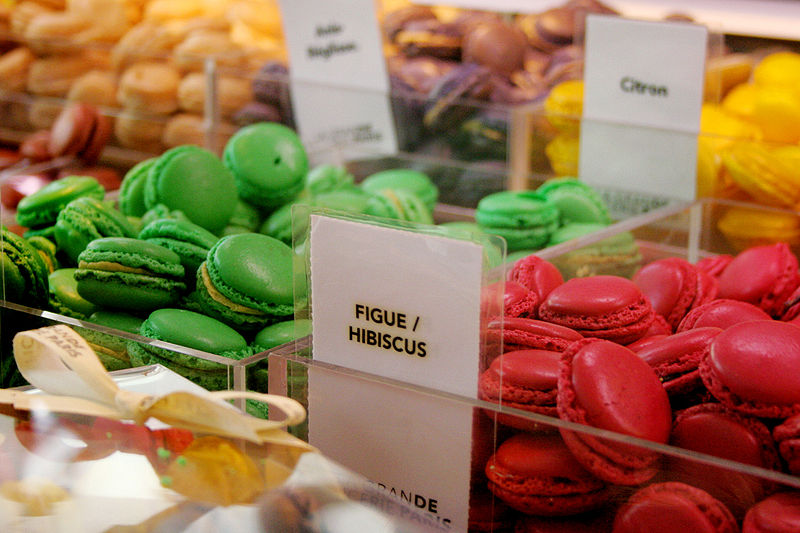
So if cupcakes are passé, here come the macarons, little jewel-like delights of pastel coloured meringue sandwiched together with a rich butter cream filling.

Macarons have been around for years in France, although the word is derived from the Italian word maccarone. It’s reputed that they were introduced to France by Catherine de Medici following her marriage to the French king, Henri II in 1553. Mind you, so much in France has been attributed to Catherine de Medici it’s probably yet another myth.

Unlike macaroons, the macaron is small, neat and incredibly difficult to make at home. The finished result must be uniform, as they are going to be sandwiched together, and have a smooth shallow-domed top ( no peaky bits) It all sounds too tricky, unless you’re really skilled in the art of meringue making.

The fillings are divine. Anything from the traditional chocolate, coffee and raspberry (appropriately coloured meringue to match he flavouring) to pistachio, chestnut, orange blossom, mango, bergamot – new flavours seem to be added every day.

If you’d like to know more, visit the website of one of the best macaron makers in France .. www.laduree.fr. They have shops in Paris and many other French cities, as well as Dublin and London (Harrods). The website should really come with a warning: ‘Macarons can become addictive’.

Thursday, March 18, 2010

Is It Really Here?


I think it’s safe to say that Spring might have arrived at last. Of course that could be a bit premature; the last time I thought that winter had finally pushed off was about a month ago, when the temperature rose, the sun shone and on a day out, we actually managed to eat our sandwiches in a picnic area without coats.

February is usually a great month for Spring-like weather in the Haute Garonne. We’re blessed with short winters which, even though they might be cold, are at least bearable. The knowledge that by the middle of February we could be sitting out in the sun gives us something to look forward too.

When I say ‘sitting in the sun’ I don’t mean I’m stretched out on a sun lounger in shorts and a strappy top ( a sight which should not be inflicted on those of a delicate disposition), it’s more like light sweater and jeans and sitting in a south-facing position.

This is what rattles me about those grumbling crumblies in the UK who have an annual chip at expat OAP’s who receive the government winter fuel allowance. For a start not every retiree gets it … it’s only paid if you were already getting it before you left the UK; everyone in receipt of a retirement pension has paid in to the system over a period of at least forty years so it’s not a charitable freebie, and lastly (and hilariously) there is a certain section of UK pensioners who actually think that south of Calais the temperature never drops below 20c. I heard an old girl on the Jeremy Kyle show rabitting on about this very subject when I was in the UK last year. Bless her heart, she actually seem to think that we were all spending the money on cheap booze and fags. I suspect she regarded anyone who left Britain to retire to pastures new as traitors and as such certainly didn’t deserve government hand-outs.

Well I can tell her that we had it cold enough to freeze the thingies off a brass monkey this year, and every winter it’s cold enough for a 15 tog duvet, so there! 150€ worth of wood keeps one room warm for about three months, providing we don’t light the fire until 6’clock in the evening and additional heating by way of radiators probably puts the electricity bill up by 75% on the summer quarters.

Not that I’m grumbling – the winters here are dry, crisp and bright even on the worst days. My recollections of East Anglian winters are dominated by memories of days that never seemed to get light. And an awful lot of mud. The roads around my village are nearly always clean, dry and mudless, but then this is cattle country, devoid of sugar beet lorries en route to the processing plant.

The garden has suddenly put a spurt on, as we knew it would once the temperatures rose, The daffodils were open enough to provide me with a Mother’s Day bouquet ( I live with a cheap skate who prefers to grow me flowers rather than buy them, but it’s the thought that counts). The crocus are always a hardy bunch, they keep coming through whatever the weather, as do the primulas which have self-sown themselves from the communal open ground at the rear of the garden. The trees have developed a delicate green haze and even our gorgeous Aubrac cows are looking happy. Yes, I’m going to stick my neck out and say “ Printemps est arrive. ”

Wednesday, February 17, 2010

Keeping Out the Cold


I really shouldn't have mentioned the fact that the snow had gone, because last week it came back again. Not in great amounts, but enough to make everything look pretty, and to send the temperatures plunging. I think this has to be the coldest winter we have experienced since we have been here; either that or it's just that I'm nine years older, so perhaps I'm feeling the cold more than I used to. I remember a few years ago some brainless Government minister suggested old people who were suffering in cold, badly heated, even more badly insulated houses, should wear a woolly hat indoors to prevent heat escaping from their heads. Well, what a brilliant idea - thousands of OAPs wearing bobble hats whilst watching 'Corrie' wrapped in a blanket ,sipping a Cup-a-Soup. Is there any wonder we escaped to France?

I do get a bit annoyed when I hear of attempts to stop ex-pats, living within the EU, receiving the British Winter Fuel Payments. There seems to be a general misconception, mostly amongst non- expat pensioners that those of us who have chosen to retire abroad are all basking in 365 days of warm sunshine, stretched out in January on the beach or the patio quaffing treble G& T's. Well, I've got news for them - nowhere in Europe has the sort of climate where you can do that, even Spain can get pretty nippy on a winter's night. And when the temperature sinks to - 12c as it does here, a G&T is the last thing you want. A cup of hot chocolate is much more attractive.

The French departments who have the Pyrénean chain as their backdrop are well versed in cold- prevention. They have plenty of warm, comfort food to off-set the effects of winter. Home- made soups are cheap, uncomplicated and nourishing, and unless we're out in the morning, and I haven't got any in the fridge from a previous lunch, we have some variety of soup every day.

In SW France, roughly within the Haute Pyrénees/ Aquitaine/Landes triangle the cold- buster is garbure, a cross between a soup and a stew - a 'stoup'as an old friend used to call it.


Garbure is such a highly regarded speciality that there are garbure festivals devoted to the dish. Argelés Gazost, near Lourdes, and Anglet, on the Atlantic coast between Biarritz and Bayonne, both have colourful festivals with traditional songs, dances and of course plates of garbure.


  • If you aren't within striking distance of either of these towns you can always make it yourself, and the good part about it is that it can be served as a lunch time soup or a main evening meal, with chunks of crusty bread. Garbure contains white beans, root vegetables, cabbage and a changing variety of meats. These can be pork, Bayonne ham, (or any jambon de campagne) confit of duck, or chicken thighs. Like all good soups it’s very much a case of throwing in whatever meat is available. Whatever is added to the basic recipe, it must be thick enough to stand a spoon up in.

    I’m going to give you the Sunday-Best, High-Days-and-Holidays recipe so you can omit some of the meat if you wish, but keep a bacon flavour by still using some pieces of jambon de campagne or a ham bone. If all else fails, some bacon lardons will do …at a push!

    For a traditional Garbure to serve 6 you will need:

    1 large onion

    4 celery stalks

    1 large leek

    4 medium potatoes, peeled

    1 medium turnip or 2 good sized carrots, peeled

    4 or 5 cloves of garlic, crushed

    250 g white haricot beans (soaked overnight)

    150 g jambon de campagne (or the bone if you can scrounge one from your friendly neighbourhood deli)

    200 g salt pork belly

    2 confit de cuisses de canard (confit of duck legs)

    2 litres water

    bouquet garni and salt and pepper.

    Half a savoy type cabbage, finely shredded.

    A large saucepan with a lid

    Scrape some of the fat from the confit de canard ( if using) into the saucepan. Otherwise cover the bottom of the pan with a light vegetable oil. Heat gently.

    Roughly chop the first 5 ingredients and add to the saucepan. Sauté lightly adding the crushed garlic after a few moments. Then add the pork and ham (or the lardons) cut into smallish cubes. Don’t brown the vegetables off too much, they just want to soften and absorb the duck fat or oil. Add the drained and rinsed haricots, the water, bouquet garni and seasoning (go easy on the salt until the final tasting). Bring to the boil, then cover and simmer for a couple of hours

    Test the beans are soft, then add the shredded cabbage and the duck legs, with most (but not all) of the fat removed. A little fat will improve the flavour and texture of the soup. Do not throw the rest of the duck fat away on pain of death! Scrape it into a bowl, and use for roast potatoes later. It makes ‘roasties’ to die for! It will keep in the fridge for several weeks

    Cook the soup for a further half hour.


    The traditional way of serving is to pour portions into a soup bowl lined with slices of day-old rustic bread, but this is not obligatory and can be messy! In more impoverished times the meat would have been removed and kept warm to be served as the main course with salad. Today the whole dish, which should by now be really rib-sticking, is usually eaten as a lunchtime treat on a chilly day with lots of freshly baked ‘pain de campagne.’ Another tradition was to pour half a glass of red wine into the last few spoonfuls of soup to ‘aid the digestion.Chacun à son goût! It's certainly á mon goût.